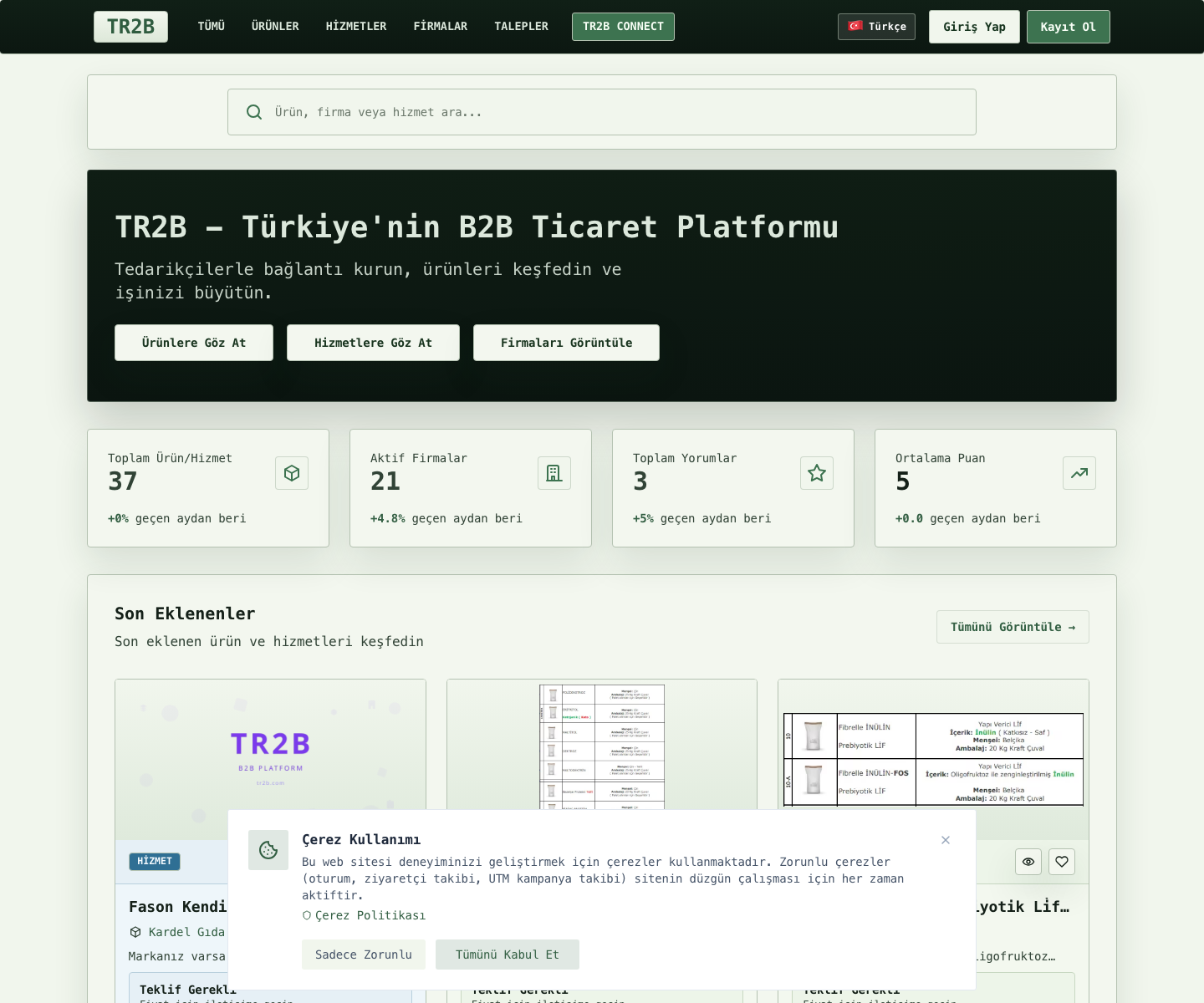
The live home page snapshot showed this as the combined inventory signal.
Visible company-profile base for Turkish suppliers, manufacturers and service providers.
Early trust signal from public review surfaces on the platform.
The rating summary visible on the home page at the time of review.
What TR2B is: a Türkiye-centered B2B operating surface
TR2B.com is not best understood as a plain directory. The public pages show a more useful pattern: product discovery, service capability, company profiles, buyer requests, Connect, Brand Market and business tools are arranged as one Türkiye-focused B2B workflow. That matters because real sourcing rarely ends on one product card. A buyer normally checks a product, asks whether a service capability exists, reads the company profile, opens or studies a request, saves options, reviews trust signals and only then moves into an RFQ file.
The live home page search box is built around products, companies and services. The visible inventory at the time of review included product examples such as polydextrose, inulin, stevia, green banana flour, transparent polyurethane hose with copper wire and shrink/body sleeve. Service examples included private-label manufacturing and filling, serial furniture production, project-based furniture production, functional soft candy, functional lozenges and vitamin gummy production. The company layer showed profiles such as Elevatorsan Innovation Tech., Atelier Emine, Kardel Gıda - Fibrelle, İlhanlar Global Endüstri ve Kimya, Fruya and Silfleks Hortum. The requests surface added active buyer intent around coconut oil, food colorants, maltitol crystal, stainless sheet and titanium dioxide alternatives.
For buyers: from search intent to a cleaner shortlist
For buyers, TR2B's value is the separation of intent. Product pages answer "what can I source?" Service pages answer "who can make or perform this?" Company pages answer "who is behind the offer?" Requests answer "can the market respond to my exact need?" This separation reduces a common sourcing problem: forcing every question into a single supplier-search page.
A good buyer flow starts with the level of certainty. If the specification is known, begin with Products. If the project needs private label, filling, processing, design, assembly or project manufacturing, start with Services. If the immediate question is trust, capacity or export readiness, move into Companies. If the need is special, publish or benchmark through Requests. TR2B helps build the first shortlist; the buyer still needs to close documents, samples, target market rules, landed cost, payment risk and acceptance criteria.
For sellers: visibility only works when it becomes evidence
For suppliers and manufacturers, TR2B provides more than a sign-up surface. The visible route structure includes company creation, product and service addition, editing pages, user dashboard, profile, reviews received and favorites. That suggests a practical operating model: the company profile becomes the trust cover page, product cards become catalog evidence, service cards become capability evidence, and reviews become an early social proof layer.
The strongest seller pages will not repeat generic claims. They should explain packaging, MOQ, target industry, private-label options, certificates, sample rules, export readiness, technical documents and contact expectations. Service pages should add machine capability, capacity, tolerances, recipe or design confidentiality, lot traceability, quality-control method and project start steps. In B2B, good content lowers the number of questions a serious buyer must ask before the first message.
For global sourcing teams: an entry map, not a final decision engine
Global buyers usually face three uncertainties when entering the Turkish market: which companies are relevant, how the product or service should be described, and what proof should be requested in the first exchange. TR2B reduces that uncertainty by placing products, services, companies and requests in public, indexable paths. The platform can accelerate discovery, but import, compliance, quality, payment and logistics decisions still belong in the buyer's own due diligence file.
This makes TR2B especially useful for multi-person teams. One person can review products, another can review services, a technical colleague can check company fit, and procurement can turn the result into an RFQ. The platform structure supports that handoff because each page type has a distinct job.
For RFQs and buyer requests: the request text is the control point
The Requests area is valuable when catalog search is not enough. But the quality of supplier responses will depend on the quality of the request. A vague "please quote" request produces vague answers. A strong request names the product standard, quantity, target use, delivery place, certificate expectation, sample need, response deadline and decision criteria.
Food ingredients need grade, allergen or additive limits, packaging, shelf life, certificate of analysis and destination market. Industrial parts need material, tolerances, surface treatment, drawing format, quantity, test method and acceptance standard. TR2B can publish the need; the buyer must make it measurable.
Connect, Brand Market and tools
TR2B Connect signals that the platform is not only a static listing environment. B2B discovery also needs relationship, repeated contact, visible expertise and profile activity. Connect can support that layer by moving users from "is there a supplier?" toward "who is active around this subject?" Brand Market and BMarket routes add another layer for brand visibility and listing depth.
The tools surface, with HSBot, HSAI, LexBot, LexAI, HS code and knowledge-base paths, points toward pre-decision research. In global trade, HS classification, terminology and regulatory language can be as important as price. Tools that help buyers phrase the need correctly can reduce wrong classification, unclear RFQs and wasted supplier conversations.
Structured data, trust and SEO
The public TR2B pages use title tags, meta descriptions, Open Graph data and JSON-LD. The home page exposes Organization and WebSite schema; list pages use ItemList patterns for products, services and companies. This is not only technical SEO. Structured data helps search engines send buyers to the right page with the right intent.
The next growth challenge is content uniqueness. As the inventory grows, each product, service and company page should avoid repeated boilerplate and should carry specific commercial proof. Search engines reward distinct pages, but serious buyers need the same thing: less generic language, more usable evidence.
Best use by audience
- Buyers: Use products and services to map the market, then narrow the shortlist with company profiles, reviews, requests and document expectations.
- Suppliers: Treat the profile as an evidence file, not a brochure. Add original product, service, capacity, certificate and export-readiness details.
- Global teams: Use TR2B as a Türkiye market entry map, then close technical and commercial due diligence with your own acceptance rules.
- RFQ owners: Make the request measurable. Product standard, quantity, target country, delivery place, sample rule and response date are not optional details.
Conclusion
TR2B's strongest promise is not speed alone. Its stronger role is order: helping buyers, suppliers and global teams move from scattered search into a clearer Türkiye B2B workflow. Used well, it can become an early-stage sourcing desk where visibility, evidence, requests and relationship signals meet before the formal purchase decision begins.
Review sources and originality note
This English edition is based on public TR2B.com pages reviewed directly. No competitor article, closed market report or copied promotional text is used; observed platform features are rewritten into an original sourcing-workflow review.
- TR2B home pagePublic TR2B page reviewed for feature mapping; no long quotation reused.
- TR2B productsPublic TR2B page reviewed for feature mapping; no long quotation reused.
- TR2B servicesPublic TR2B page reviewed for feature mapping; no long quotation reused.
- TR2B companiesPublic TR2B page reviewed for feature mapping; no long quotation reused.
- TR2B business requestsPublic TR2B page reviewed for feature mapping; no long quotation reused.
- TR2B ConnectPublic TR2B page reviewed for feature mapping; no long quotation reused.
- TR2B Brand MarketPublic TR2B page reviewed for feature mapping; no long quotation reused.
- TR2B toolsPublic TR2B page reviewed for feature mapping; no long quotation reused.